Fire, Rescue & Municipal Fleets
When a commercial truck is down, a company loses revenue. When an engine, an ambulance or a public works truck is down, a district loses coverage. We schedule that work differently, and we say so up front.
Truck & Fleet
Idle hours, not odometer miles, wear these units out
An emergency vehicle spends much of its life stationary with the engine running: on scene, at the bay door, at a staging point, holding at a hospital. The odometer barely moves while the engine, the charging system and the aftertreatment all accumulate hard hours. That is the single most useful thing to understand about maintaining these units, and it is why a maintenance plan built on mileage quietly fails them.
Low-temperature idling is especially punishing on diesel aftertreatment: exhaust never gets hot enough for passive regeneration, soot loads, active regens multiply, and eventually the unit derates at exactly the wrong moment. We set intervals on engine hours, watch soot load as a maintained metric rather than a warning, and repair the sensors, EGR and injection faults that make the cycle worse.
GSA Fleet Approved Service
Allstate Auto & Truck Repair Inc. is an approved service provider for GSA Fleet vehicles. If you drive a GSA-leased unit, repairs here go through the same authorization your agency already uses and the work is billed to GSA rather than to you at the counter. No purchase order to chase down, and no paying out of pocket to be reimbursed later.
State and municipal fleets are welcome on the same terms: agency billing, purchase orders and documented repair records on every unit. Call (904) 683-6707, ask for Ray, and say which agency or district you are with.
The body draws as hard as the chassis
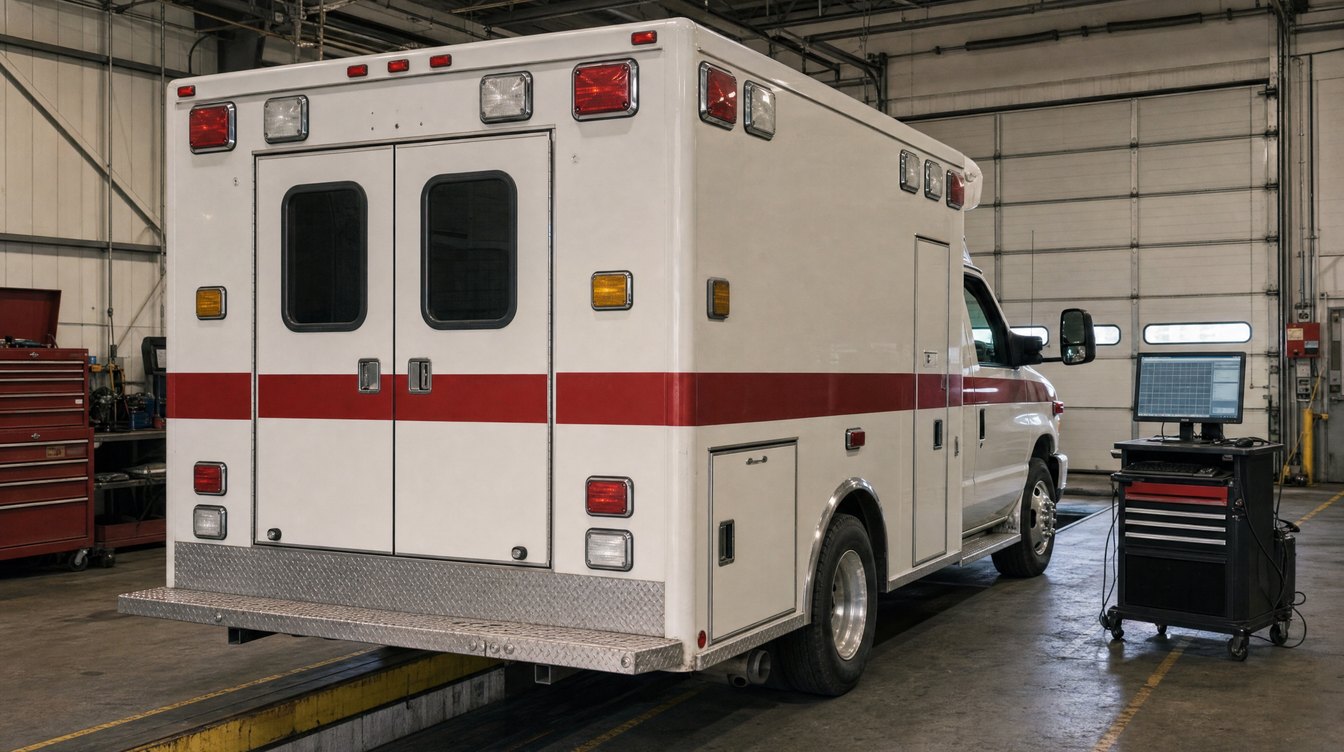
Scene lighting, sirens, powered cots, inverters, radios, climate control for a patient compartment and shoreline charging all pull current, often with the engine at fast idle or off entirely. Charging systems and battery banks on these units live a life no over-the-road tractor would recognize, and they fail in ways that look mysterious until someone measures them properly.
So we treat the electrical system as a primary system, not an accessory: individual battery testing across the bank, alternator output under real load, shoreline and inverter circuits, grounds and cable ends, and parasitic draw with everything keyed off. The same applies to cooling and air conditioning, which have to hold temperature at idle in August with a crew and a patient aboard.
Fire apparatus is its own discipline
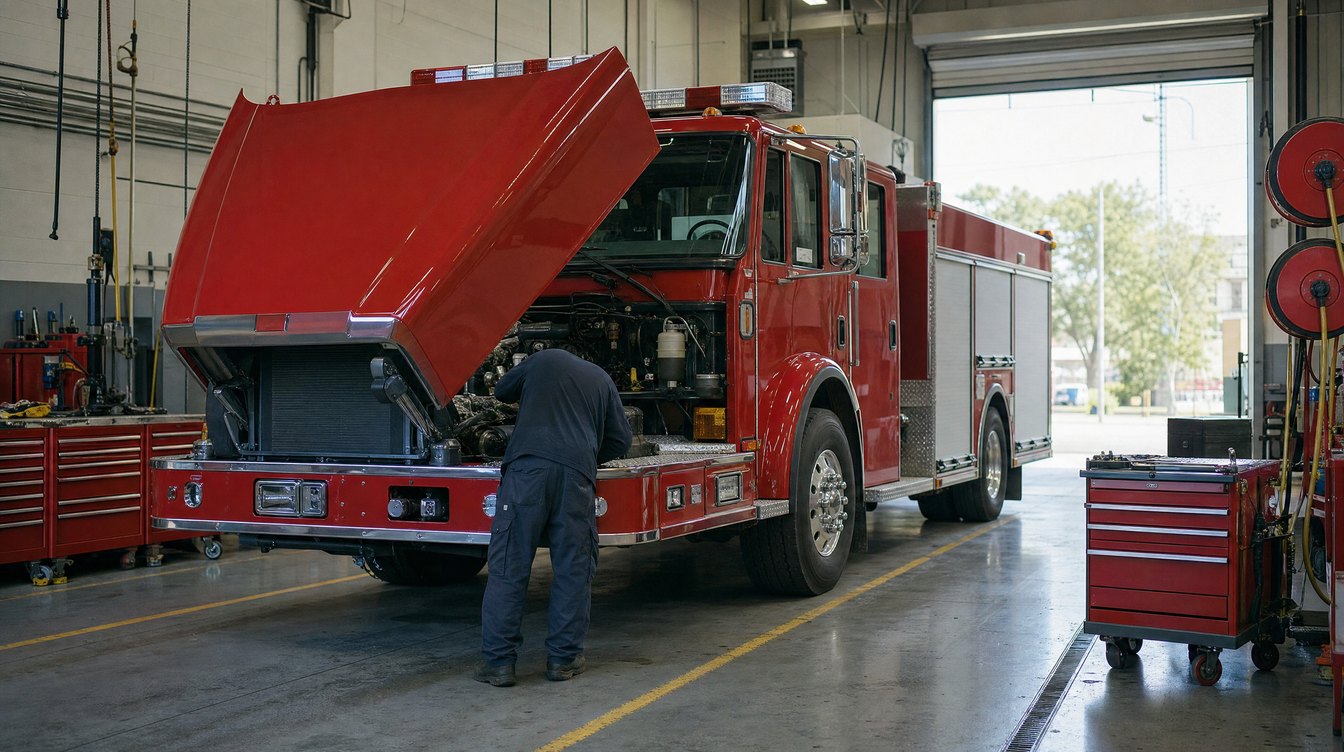
A pumper or rescue truck is a heavy chassis carrying a purpose-built body, and the two need different attention. On the chassis side it is the work we do every day: diesel engine, driveline, air brakes, steering, suspension and cooling on a vehicle that is heavy even before water goes in it. On the body side the demands are specific, from pump and aerial drive hydraulics and PTO engagement to the electrical load of scene lighting and onboard equipment.
These trucks also sit far more than they run, and sitting is its own kind of wear: batteries discharge, seals dry out, coolant additives deplete and brakes corrode while the odometer stays still. We build service intervals around that reality rather than mileage, and we work around your response coverage so a unit is never out of service longer than the repair actually requires.
Scheduling around coverage, and documenting everything
These fleets cannot simply park a unit for a week, so we plan around shift changes and spare-unit availability, give realistic timelines instead of optimistic ones, and separate clearly what has to be fixed before the unit returns to service from what can wait for the next scheduled visit.
Every repair closes out in writing: the findings, the measurements taken, the parts fitted and the items we chose to defer. Public agencies and municipal departments need that paperwork for reporting and procurement files, and it is the same standard we hold on DOT inspections and commercial accounts.
Emergency and municipal work we handle
Fire, Rescue & Municipal Fleets: scope of work
- Fire apparatus and pumper chassis service
- Ambulance and rescue chassis diesel service
- Aftertreatment, regen and derate diagnosis on high-idle units
- Charging systems, battery banks, inverters and shoreline circuits
- Air conditioning for cab and patient or crew compartments
- Air and hydraulic brake systems, suspension and steering
- Aerial, pump and body hydraulics, PTO and power take-off drives
- Public works and utility truck service and DOT inspections
Questions we hear
Straight answers
Our ambulance keeps derating even though the mileage is low. Why?
Because mileage is the wrong measure for these units. Long idles never build enough exhaust heat for passive regeneration, so soot accumulates on engine hours the odometer never shows. We read the aftertreatment data, clear the underlying cause and put the unit on an hours-based interval so it stops repeating.
Do you work on fire apparatus as well as ambulances?
Yes. Fire and rescue apparatus are heavy chassis with specialized bodies, and the chassis systems are exactly what this shop works on daily. Call us with the apparatus and chassis details and we will tell you plainly what we can take in house.
Can you work around our shift schedule and spare unit availability?
Yes, and we plan it that way from the start. Tell us how many units you run and how many spares you have, and we will schedule around coverage rather than around our bay board.
Do you provide documentation for our records?
Yes. Every unit leaves with written findings and a record of what was measured, replaced and deferred, which is what agency reporting and procurement files ask for. Call us to discuss billing arrangements for departmental accounts.
Keep looking
Related services
Fleet Services
One shop for your whole fleet: scheduled maintenance, inspections, repairs and records that survive an audit.
See this service SVC 02Regen Systems
Forced regens, stuck regens and the reasons behind them: sensors, EGR, injectors and duty cycle, diagnosed properly.
See this service SVC 03Batteries & Charging Systems
No-starts, dead banks and parasitic drains on multi-battery truck systems, tested rather than guessed.
See this serviceWhere we serve
Fire, Rescue & Municipal Fleets across Northeast Florida
One shop at 3190 W Beaver St in Jacksonville, with customers from every direction: